
This guide was contributed by Tokyo Expat, a bilingual English and French relocation and property-hunting service for foreigners moving to Tokyo. The rent figures come from its Tokyo Rent Index. The index is built on over 500,000 real rental listings.
Tokyo is not one rental market; it is 23 of them. The city is divided into special wards, and the difference in rent between them is large enough to change your budget and your entire daily life. For a foreigner arriving without a feel for the map, this is one of the most useful things to understand early on, because where you choose to live determines how much you pay, how long you commute, and how at home you feel. Here is a practical, ward-by-ward orientation to renting in Tokyo.
First, decode the apartment sizes
Before comparing wards, you need to read Japanese listings. Apartments are described by a number plus letters: R (room), K (kitchen), DK (dining-kitchen), and LDK (living-dining-kitchen). A 1K is one room plus a small separate kitchen. It is the typical compact single-person apartment. A 1LDK is one bedroom plus a proper living-dining space. It is the usual target for a couple or someone who wants room to breathe. Families tend to look at a 2LDK or 3LDK. For the same budget, you get markedly different layouts from one ward to the next, so location and size have to be considered together.
The affordable outer wards
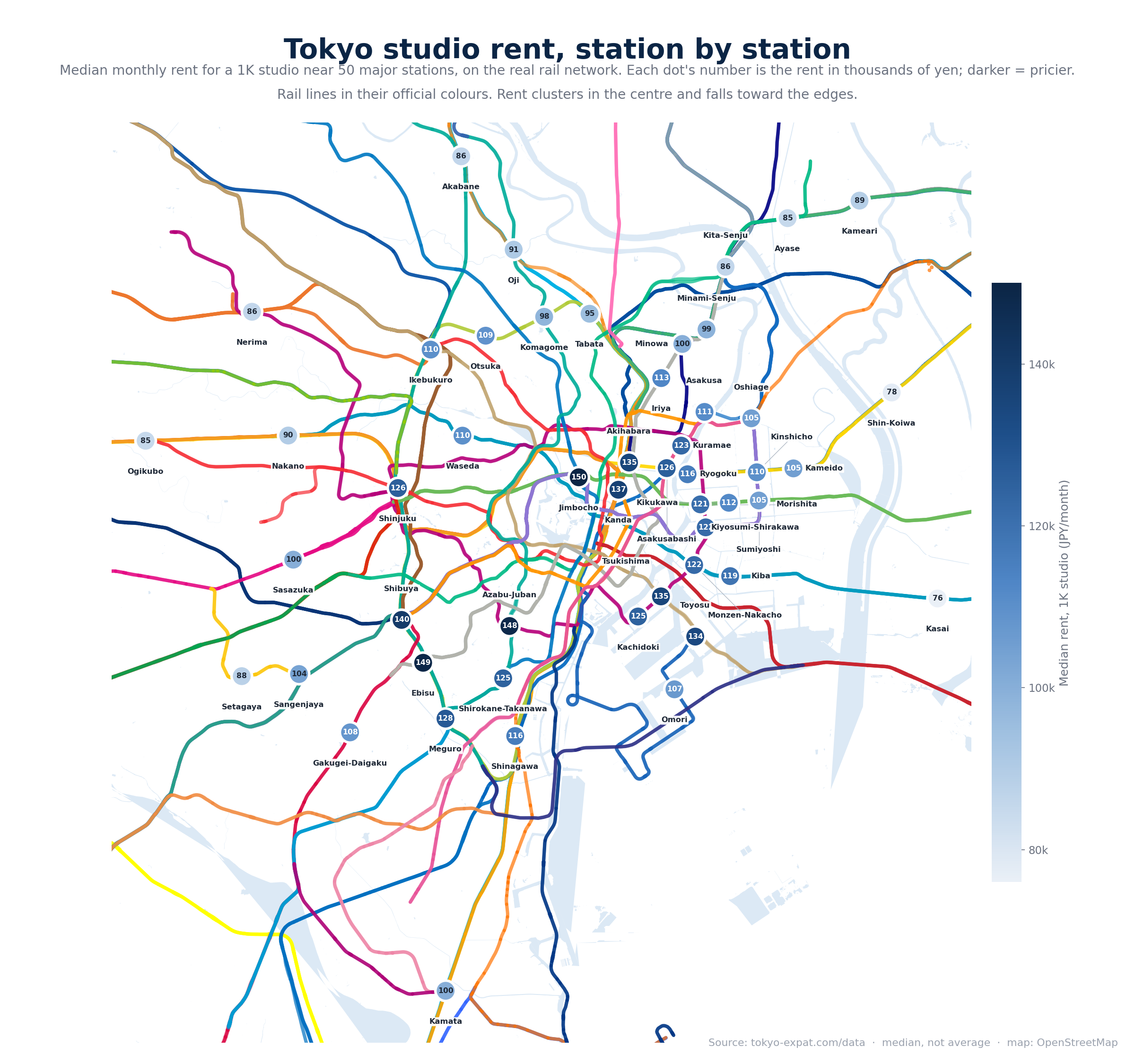
If your priority is space and value, look to the outer wards. Areas like Edogawa, Adachi, Katsushika, and Nerima are further from the centre, but rents there are noticeably lower. A compact 1K in these wards commonly costs JPY 74,000 to JPY 85,000 a month, and you get a real apartment for your money, not a shoebox. The trade-off is commute time: you may spend 30 to 45 minutes reaching central offices. For students, young professionals, or anyone who values square metres over a prestige address, these wards are often the smartest choice, and they are safe, pleasant places to live.
The mid-range wards
Between the extremes are wards like Nakano, Suginami, Toshima, and Koto. Rents here are reasonable, and commutes are shorter than from the outer wards, while the neighbourhoods keep a real character of their own. This is where many long-term foreign residents end up once they know the city, because you get most of the convenience of central Tokyo without paying central Tokyo prices. A 1K here typically costs JPY 85,000 to JPY 110,000, and a working couple can still stretch to a 1LDK.
The premium central wards
At the top of the market are the central and western wards behind Tokyo's international reputation: Minato, Shibuya, Chiyoda, Meguro, and Shinjuku. This is where you find the embassies, the international schools, the English-friendly services, and the most sought-after neighbourhoods. It is also the most expensive part of the city. A 1K in central Minato can cost around JPY 140,000. That is nearly double the price of the cheapest outer wards. A desirable 1LDK costs anywhere from roughly JPY 120,000 to JPY 260,000, and often more. You are paying for location, convenience, easy access to international schools, and a certain lifestyle, and for many relocating executives and families, it is worth it. Just go in knowing the premium is real.
The costs beyond rent
Whichever ward you choose, budget for the upfront bill, which almost every newcomer underestimates. Landlords can ask for four to six months of rent all at once before you move in. This typically includes a deposit (shikikin), key money (reikin, a non-refundable payment to the landlord), an agency fee, a guarantor company fee, and the first month of rent. You can soften the blow in two ways: look for listings marked reikin zero to skip key money, and remember that guarantor companies now stand in for the Japanese guarantor that landlords traditionally required, so not knowing a local sponsor is no longer a barrier.
How to choose a ward
The single most useful habit is to choose your train line and commute before you fall in love with a neighbourhood. In Tokyo, a cheaper, further-out ward on the right line can feel more central than an expensive one on an awkward route. Work out where you will commute most days, identify the two or three lines that get you there quickly, and then look at the wards along those lines within your budget. Get this right, and you avoid the most common and expensive mistake foreigners make: paying a premium for a central address that turns out to have a worse daily commute than a cheaper option one line over.
It also helps to weigh what you actually need. Families usually prioritise proximity to an international school and larger layouts, so they tend to settle in Minato, Setagaya, or Meguro. Single professionals often do best in the mid-range wards. They trade a few minutes of commute for a much better apartment. Students and newcomers on a budget lose nothing by starting in an affordable outer ward or a share house, then moving inwards once they know the city.
A realistic picture
Put together, here is the range. A single person can find a functional 1K from roughly JPY 74,000 in the outer wards to about JPY 140,000 in central Minato. A couple looking at a 1LDK should plan for anywhere between about JPY 120,000 and JPY 260,000, depending on how central and how polished they want to be. These are real market figures, and the spread is the whole point: people who understand the map get far more for their money than those who pick a ward at random.
Renting in Tokyo as a foreigner is manageable once you understand that the ward you choose is the biggest single lever on both your budget and your quality of life. Decode the layouts, respect the upfront costs, choose your commute first, and match the ward to your real priorities. Do that, and you will find a home that fits your life and your wallet in one of the most rewarding cities in the world to live in.