
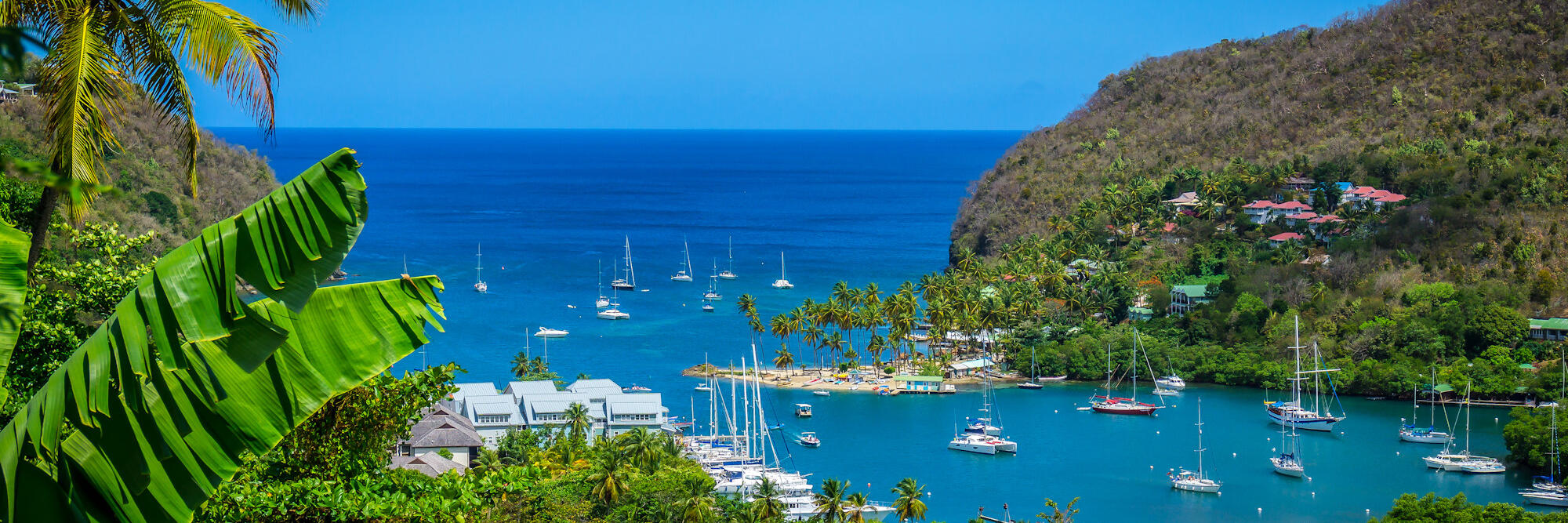
Expats moving to St Lucia will find a small, mountainous island in the eastern Caribbean, recognised by the twin Pitons, a pair of volcanic peaks on the southwest coast. There's rainforest in the interior, sulphur hot springs near Soufrière, working banana farms, and beaches along much of the coast.
St Lucia is an independent country and part of the Lesser Antilles. Its nearest neighbours are Martinique to the north and Saint Vincent to the south, and Barbados is a short hop east.
Living in St Lucia as an expat
Expats living in St Lucia can join a small but growing international community. Settling in is usually easy. English is the official language, and Saint Lucians have a warm, easygoing reputation. You'll also hear Saint Lucian French Creole, known locally as Kwéyòl, almost everywhere you go.
Tourism is the mainstay of the economy, and agriculture and a small financial services sector are the next biggest. Most newcomers aren't here for work though. The typical expat is a retiree, a remote worker, a second-home owner, or an investor who has bought into the island's residency or citizenship programme. The comparatively low cost of living is a big draw.
By European or North American standards, property is affordable, particularly away from the coast. Freestanding homes inland are far cheaper than the modern condos and beachfront villas in the resort areas. Most expats settle in the north. Rodney Bay and neighbouring Gros Islet are the hub, and the upmarket Cap Estate is just beyond. This is where you'll find most of the island's shopping, dining, nightlife, and its main marina.
Getting around is reasonably straightforward on such a compact island. Driving is on the left. Main roads are generally decent, but they're steep and winding in places, so a 4x4 is useful for the rougher tracks and more remote beaches.
Privately run minibuses are the main form of public transport. They're cheap, but they run on demand rather than a fixed timetable, and there are fewer in the evenings and almost none on Sundays. There are also (unmetered) taxis, so agree the fare before you set off, and expect to pay more over longer distances. There's no Uber or Bolt on the island.
Healthcare on the island is adequate for routine needs. The main public hospital is the Owen King EU Hospital in Castries, and there are private options too, including Tapion Hospital. For anything serious or specialised, though, you may need to be flown abroad, so it's strongly advised to get comprehensive health insurance that covers treatment overseas and emergency evacuation. Most expats prefer to use private care over the public system.
Cost of living in St Lucia
By Western standards, the cost of living in St Lucia is reasonable, especially if you shop and eat like a local. Fresh produce, fish, rum, and local beer are cheap, and small eateries are easy on the wallet.
The catch is imported goods. Anything shipped in, whether cars, electronics, imported food, or familiar household brands, is expensive, thanks to steep import duties. Electricity is pricey too, especially once you're running the air conditioning. St Lucia is cheaper than flashier islands like Barbados or the Bahamas, but it's not the bargain that somewhere like the Dominican Republic can be.
Families and children in St Lucia
Families in St Lucia will find an education system built on the British model. There are public and private schools across the island, and many of the private ones are Catholic, in keeping with the island's heritage. International options are thin on the ground, though. The main one is the International School of St Lucia near Rodney Bay, which follows a Canadian curriculum and takes on most of the island's expat children. A handful of private and Montessori schools are available for younger children.
The island is geared to the outdoors, and families spend their weekends sailing, swimming, hiking, and mountain biking. Some of the biggest events on the calendar are worth planning around, such as Saint Lucia Carnival in July, the Saint Lucia Jazz Festival, Jounen Kwéyòl (Creole Day) in October, and the La Rose and La Marguerite flower festivals.
Climate in St Lucia
The climate in St Lucia is hot and humid all year, although there's usually a northeast trade wind to take the edge off. There's little change in temperature from season to season, but there is seasonal variability in rainfall. The dry season is roughly December to May; the wet season, which overlaps with the Atlantic hurricane season, is June to November.
Direct hurricane hits are rare, as the island is far enough south to miss most of the big storms, but tropical storms and heavy downpours are part of life from summer onwards.
Expats who want a slower, outdoor-focused life tend to settle in well, provided they can live with the realities of a small island: a limited job market, basic healthcare, the annual hurricane season, and steep prices on anything imported. For retirees, remote workers, second-home owners, and anyone drawn to the beaches and the warm climate, that trade-off is usually worth making.
Fast facts
Official name: Saint Lucia
Population: Around 180,000
Capital city: Castries (also the largest city)
Other cities: Gros Islet, Vieux Fort, Soufrière, and Micoud
Neighbouring countries: St Lucia has no land borders. Its maritime neighbours are Martinique to the north, Saint Vincent and the Grenadines to the south, and Barbados to the east.
Geography: St Lucia is a volcanic island in the eastern Caribbean, part of the Lesser Antilles. The interior is mountainous and covered in rainforest, and there are fertile valleys and many short rivers. Its best-known features are the twin Pitons on the southwest coast and the geothermal sulphur springs near Soufrière.
Political system: Parliamentary democracy under a constitutional monarchy
Major religions: Christianity, mainly Roman Catholic. Protestant denominations and Rastafari are also present.
Main language: English (official). Saint Lucian French Creole, known locally as Kwéyòl, is widely spoken.
Money: The East Caribbean dollar (XCD) is divided into 100 cents. It is shared by eight members of the Eastern Caribbean Currency Union and pegged to the US dollar. New residents can open a local bank account, although banks usually ask for references and proof of address, and the process can be slow.
Tipping: Many hotels and restaurants add a service charge of about 10 percent, so check the bill before adding more. Where it isn't included, 10 to 15 percent is normal for good service. A small tip for taxi drivers is appreciated.
Time: GMT-4
Electricity: 240V, 50Hz. UK-style three-pin plugs (Type G) are standard.
Internet domain: .lc
International dialling code: +1 758
Emergency contacts: 911 (fire and ambulance); 999 or 911 (police)
Transport and driving: Cars drive on the left-hand side of the road. Public transport is limited, so minibuses and taxis are the most common way to get around.