
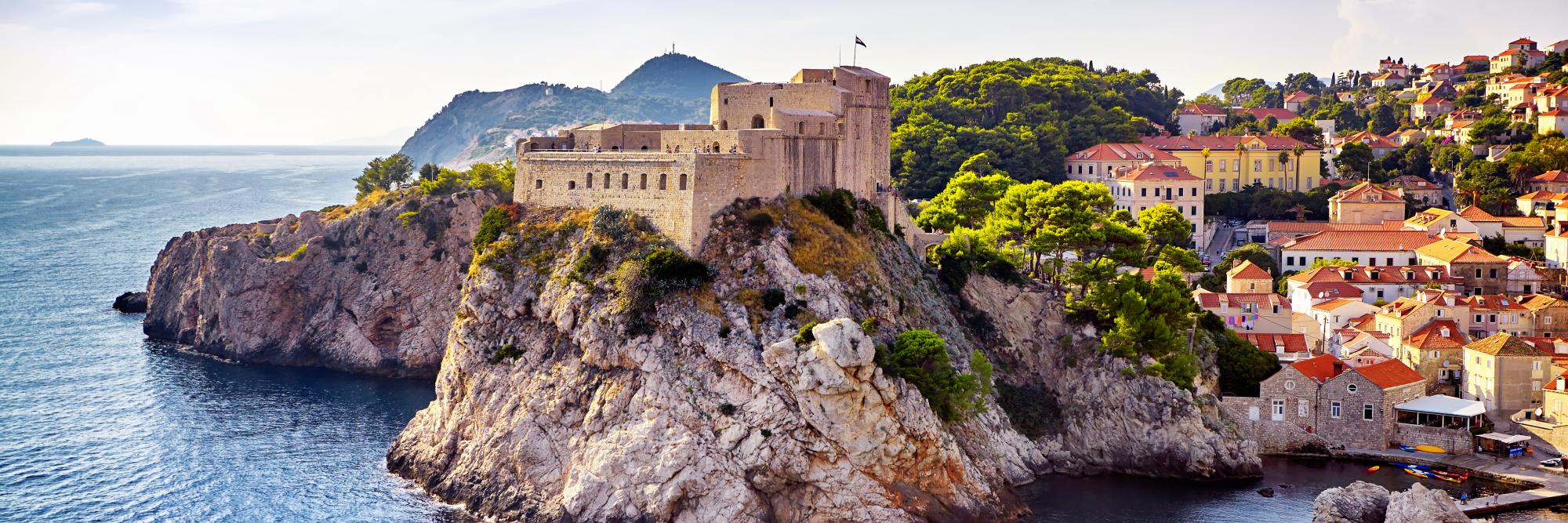
Expats moving to Croatia find a home in one of Europe’s youngest countries, which has been independent since 1991 and an EU member since 2013. For decades, holidaymakers have come for the historic forts and basilicas as much as the clear Adriatic waters and national parks, and a growing number now stay on as residents.
Many expats move here for a lower cost of living than in Western Europe and a slower pace of life. Locals on the Dalmatian coast even have a word, fjaka, meaning a contented, sun-drowsy idleness. Remote workers from outside the EU can apply for a dedicated digital nomad permit, and banking and cross-border travel have been simpler since the switch to the euro and entry into the Schengen Area in 2023.
Living in Croatia as an expat
Anyone living in Croatia as an expat will find the biggest foreign communities in Zagreb, the capital, and Split, Dalmatia’s main city. Plenty of foreign residents also choose Istria or the area around Dubrovnik. Tourism is worth roughly a fifth of Croatia’s GDP, and more and more newcomers set up hospitality businesses along the coast and in smaller rural areas.
Employers in tourism and construction are so short of staff that they recruit tens of thousands of workers from abroad every year. Professional roles for non-Croatian speakers are much harder to come by, and salaries are low by Western European standards, so many expats skip the local job market and work remotely for companies based elsewhere.
Entrepreneurs who set up their own businesses face a thicket of red tape, and non-EU citizens can wait months for a residence permit. Corruption is also perceived to be higher in Croatia than in most EU countries, so you should be wary of officials who promise to speed things up. The government welcomes foreign investment, all the same.
Retirees and second-home buyers have long had their eye on Croatia’s sunny coastline and island villages, and holidaymakers have dubbed parts of Istria ‘New Tuscany’ for its hilltop towns and truffle-rich hinterland. Property prices in Zagreb and on the coast are far higher than they were a decade ago. Many coastal landlords prefer lucrative holiday lets to long-term tenants, so year-round rentals can be scarce and expensive.
Coastal towns are packed with visitors in July and August and far quieter in winter, when many restaurant and shop owners close up until spring. Some landlords only rent out apartments from autumn to late spring, before the summer crowds arrive.
Public transport in Croatia is less extensive than in much of Western Europe, and rural timetables can be patchy. Buses are the most popular way to travel between towns and cities, and fares are reasonable. Zagreb and Osijek also have tram networks, and the compact old towns of most cities are easy to get around on foot.
Train fares are cheap, but the rail network is limited, and there’s no line to Dubrovnik at all. HŽPP, the national passenger operator, has bought dozens of new trains in recent years, and passengers on many routes now travel in modern carriages. Jadrolinija, the state-owned ferry company, runs year-round routes to the islands, but it cuts back sailings considerably outside the summer season.
Croatia’s motorways are modern and well maintained, and most of them are toll roads. Nervous drivers may find the winding mountain roads and sheer drops elsewhere a challenge. Petrol (gas) stations can be few and far between on the way to small towns, so fill up before you set off on a long journey.
Legal residents pay into the state health insurance fund (HZZO) and can then use Croatia’s universal public healthcare system. Standards in public hospitals are generally good, but patients can wait months to see a specialist or have a non-urgent procedure. Most residents take out an inexpensive supplementary policy to cover co-payments, and expats who can afford it often go private for faster treatment. Croatia is a popular destination for medical tourists, and dental treatment is a particular draw.
Cost of living in Croatia
Newcomers from Western Europe or North America usually find the cost of living in Croatia lower than at home. Prices are considerably higher than they were before the switch to the euro in 2023, though, and Croatian inflation has been among the highest in the eurozone. Local salaries are modest by Western European standards, so expats who earn a foreign income get the most bang for their buck.
Accommodation and international school fees are likely to be the biggest expenses. Rental growth in Croatia has been among the fastest in the EU in recent years, and rents are highest in Zagreb and on the coast.
A meal at a traditional konoba (tavern) is good value, but restaurateurs on the busiest tourist strips charge a hefty premium in summer. Most towns have an open-air produce market, or tržnica, where you can pick up fresh, seasonal fruit and vegetables at reasonable prices.
Families and children in Croatia
State primary and secondary schools are free for families and children in Croatia, and the children of foreign residents can enrol on the same terms as locals. Lessons are in Croatian, and pupils who don’t speak the language get extra Croatian classes. Primary school is compulsory, and children attend for eight years. Croatian pupils score close to the OECD average in international assessments, and literacy is almost universal.
Expat parents who want their children to continue with a familiar curriculum in a familiar language can choose from a handful of private international schools. Most are in Zagreb, which has British, American, French, and German options, and there are a couple in and around Split. Fees are high, and the most popular schools have waiting lists.
Many families spend their summers on the Adriatic’s beaches and islands, and plenty head inland to hike in densely forested mountains such as Gorski Kotar. In the cities, children can visit museums, art galleries, water parks, and beaches. Plitvice Lakes National Park is a favourite family day trip. Its 16 terraced lakes are linked by waterfalls, and visitors follow wooden boardwalks right over the water.
Climate in Croatia
New residents quickly learn that there are two distinct climates in Croatia: Mediterranean on the coast and continental inland. Summers are hot and dry on the coast, whereas summer thunderstorms are more common inland. Typical summer temperatures on the coast are 78°F to 86°F (26°C to 30°C). The continental interior is a little cooler at 71°F to 78°F (22°C to 26°C), and the mountains are cooler still at 59°F to 68°F (15°C to 20°C). Heatwaves are increasingly frequent, and temperatures above 95°F (35°C) are no longer unusual in July and August.
Winters on the coast are mild and wet, and average January temperatures there are around 43°F to 46°F (6°C to 8°C). The bura is a cold, fierce wind from the northeast, and the authorities sometimes close coastal bridges and roads when it’s at its strongest. Inland winters are much colder, and average January temperatures there are around 32°F (0°C). Snow is fairly common in the interior and heaviest in the mountains.
Many new arrivals happily put up with the paperwork and higher prices in exchange for Croatia’s natural beauty and outdoor lifestyle. Anyone moving to Croatia with a taste for adventure will find no shortage of islands to hop between, trails to hike, rivers to raft, and old towns to stroll through.
Fast facts
Official name: Republic of Croatia
Population: Around 3.9 million
Capital city: Zagreb (also the largest city)
Other cities: Split, Rijeka, Osijek, Zadar
Neighbouring countries: Croatia’s neighbours are Slovenia to the northwest, Hungary to the northeast, Serbia to the east, Bosnia and Herzegovina to the east and south, and Montenegro to the southeast. Croatia also has a maritime border with Italy across the Adriatic Sea.
Geography: Croatia has 1,244 islands, islets, and rocks along its Adriatic coastline, but only around 50 of them are inhabited. The north and east of the mainland are mostly flat, fertile plains, and the Dinaric Alps are a mountainous barrier between the interior and the coast.
Political system: Unitary parliamentary constitutional republic
Major religions: Christianity (mainly Roman Catholicism)
Main language: Croatian (official). Many Croatians speak English well, and younger generations are generally the most confident.
Money: The euro (EUR) is divided into 100 cents. ATMs are plentiful, and it’s relatively easy to open a bank account once you have a personal identification number (OIB).
Tipping: Tips aren’t compulsory, but around 10 percent is customary in restaurants for good service. In cafés and taxis, most Croatians simply round up.
Time: GMT+1 (GMT+2 from the last Sunday in March to the last Sunday in October)
Electricity: 230V, 50Hz. Two-pin, round-prong plugs are used.
Internet domain: .hr
International dialling code: +385
Emergency contacts: 112 (all emergencies), 192 (police), 193 (fire), 194 (ambulance)
Transport and driving: Croatians drive on the right-hand side of the road. Buses are the main form of public transport between towns and cities, and Jadrolinija and other ferry operators run routes between the mainland and the islands. Trains are infrequent but useful on some regional routes.