
- Download our Moving to Hong Kong Guide (PDF)
Getting around Hong Kong is easy thanks to its excellent public transport system and compact layout. Driving here is a luxury rather than a necessity, and in some cases, it can even be a bit of an annoyance because of traffic jams and expensive parking. Even expats who live off-island do not need to invest in a private vehicle. Kowloon is almost as compact as Hong Kong Island and just as densely populated, so its public transport network is more convenient than a car.
Public transport in Hong Kong
Hong Kong’s public transport system is a well-integrated network of trains, buses, trams, and ferries. All four modes of public transport can be accessed using a contactless smartcard known as an Octopus card, which you tap on a reader as you travel.
Contactless bank cards and phone wallets, such as Apple Pay and Google Pay, are now accepted across most of the network, so a physical Octopus card is no longer essential. It is still the handiest option, though, since you can also use it on minibuses and in many small shops.
Mass Transit Railway (MTR)
The most popular mode of transport in Hong Kong is the MTR, the city’s rapid transit system. It is extremely efficient and clean, and has added perks like air conditioning and consistent mobile phone reception underground. Commuters also have the advantage of avoiding the street-level congestion above.
The MTR system consists of light and heavy rail. The heavy rail network has around ten lines and roughly 100 stations across Hong Kong.
When riding the MTR, expats should keep in mind that Hong Kongers are perpetually in a hurry. It’s best to keep pace with the crowd and move quickly, particularly at busy interchange stations.
Buses
Buses are a popular mode of transport in Hong Kong, particularly for residents who don’t live near an MTR line. They are usually less packed than the MTR, but are subject to the same slow-moving traffic as private vehicles.
Fares are payable on board. You can tap an Octopus card or a contactless bank card, or pay with exact cash, since drivers give no change. The four major franchised operators are Kowloon Motor Bus, Citybus, New Lantao Bus, and Long Win Bus.
Public light buses, or minibuses, are a common sight as well. Green minibuses run fixed routes and fares, while red minibuses set their own routes and fares and will stop on request.
Trams
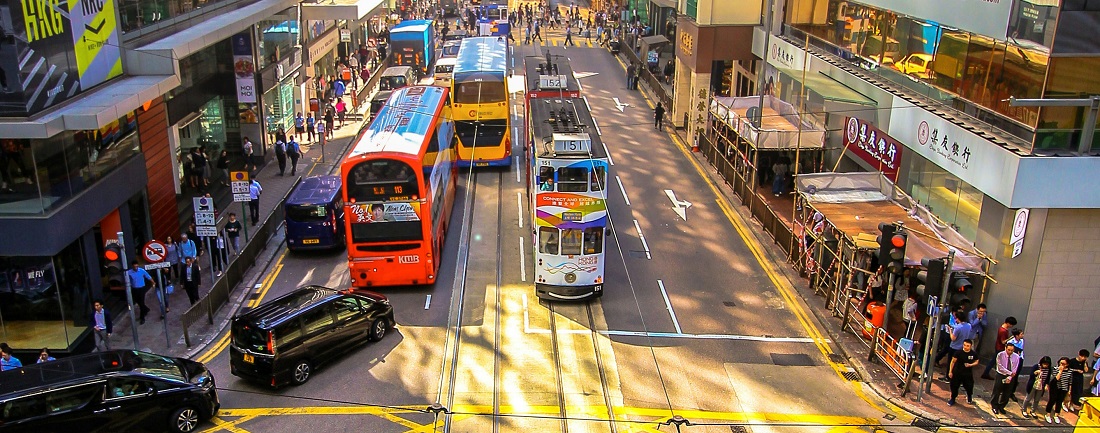
A limited network of historic trams is available along the north shore of Hong Kong Island, from Kennedy Town to Shau Kei Wan, plus a short loop through Happy Valley. While they’re worth riding once or twice for the novelty, they are a slow mode of transport and don’t make for a good daily commute. You pay the same flat fare, however far you travel. As with the bus, have exact change ready if you are paying cash, since no change is given.
Ferries
The ferry is an essential mode of transit for expats living in Discovery Bay, Lamma Island, Park Island, or any of the other outlying islands favoured by foreigners.
Ferries are subject to Hong Kong’s occasionally extreme weather, and services can be suspended altogether during a typhoon. When the Observatory raises Typhoon Signal No. 8 or higher, most public transport stops running, ferries included, and employers usually send staff home early. If you get stranded in a storm, it helps to have somewhere nearby to wait it out.
Useful links
Taxis in Hong Kong
Taking a taxi in Hong Kong is relatively cheap compared with cities like Tokyo or parts of Western Europe. Many drivers speak little English and may not recognise destinations given in English, so it helps to have your address written in Chinese or ready to show on your phone.
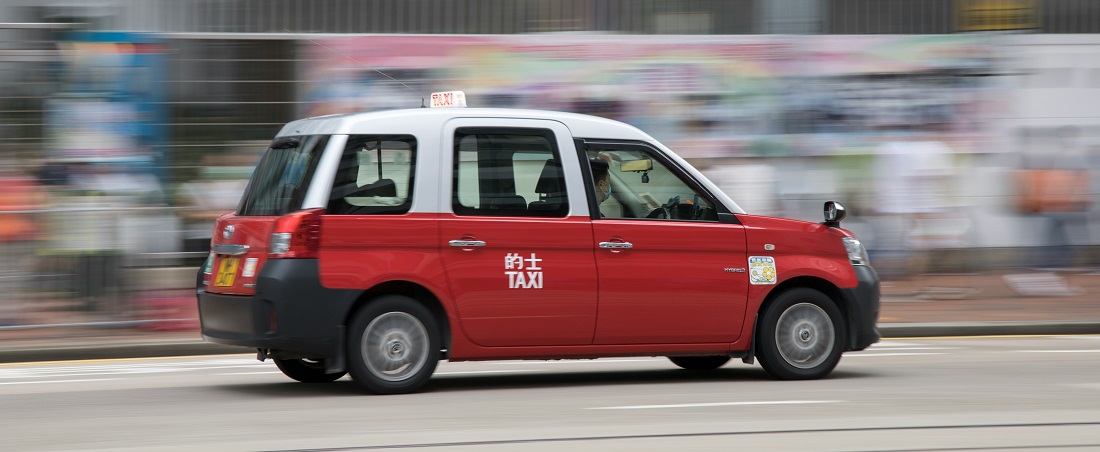
There are three types of taxis: red, green, and blue, each of which serves a particular area.
- Red taxis service most of Hong Kong, except the south side of Lantau Island and Tung Chung Road.
- Green taxis operate in the New Territories.
- Blue taxis only operate on Lantau Island.
Ride-hailing apps such as Uber also operate in Hong Kong and can help you get around language barriers. Hong Kong has now passed laws to license and regulate ride-hailing platforms, vehicles, and drivers, and the new system is being phased in through 2027.
Useful links
Driving in Hong Kong
For most new arrivals, driving in Hong Kong is more hassle than it is worth, and buying a car is rarely necessary. The region is small, and the costs of buying and parking a car are high. That said, it is still a common mode of transport for expats, especially those who choose accommodation further from the city centre.
Hong Kong has a good road safety record, but expats are advised to take extra caution when driving. Traffic jams are frequent, so be prepared to spend a significant amount of time on the road.
Driver’s licences
Expats from countries with exchange (direct issue) agreements can convert their foreign driver’s licence to a local one without a test. You generally need a full licence from an approved country that is still valid (or expired no more than three years ago). You will need to produce your Hong Kong ID card, proof of address, and your original overseas licence, plus a certified translation if it is not in English or Chinese.
Those who are not from countries with licence-exchange agreements can apply for a temporary driver’s licence and will usually need to pass a Hong Kong driving test to obtain a full local licence.
Useful links
Walking and cycling in Hong Kong
Walking around Hong Kong is relatively safe, and pedestrians tend to keep to the marked crossings and their signals. Cycling is a tougher proposition because the city is not especially bicycle friendly. Cyclists mostly share the roads, which can be dangerous on highways and after dark.
If you plan to walk or cycle, keep an eye on air pollution levels and avoid prolonged outdoor exercise when they are high. You can check the government’s Air Quality Health Index (AQHI) for guidance on when the general public should ease off outdoor exertion.