
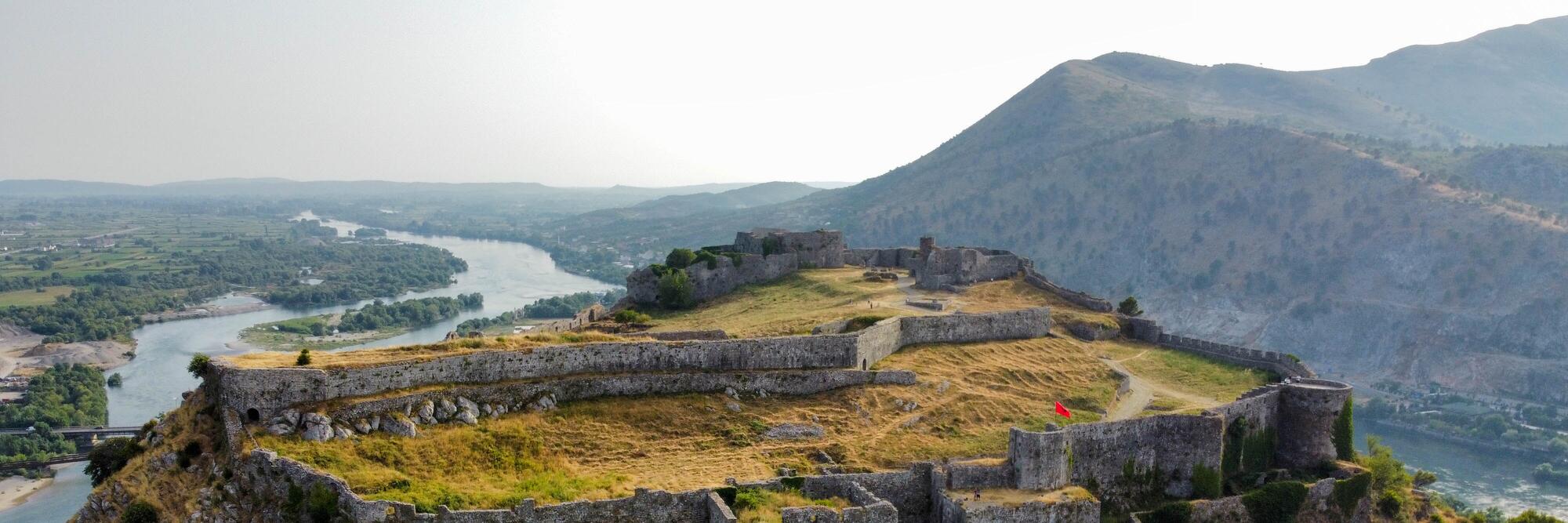
Moving to Albania puts you in Southeastern Europe on the Balkan Peninsula. The country has pristine Adriatic and Ionian coastlines and the imposing Albanian Alps. Albania transitioned rapidly from Ottoman rule to a sovereign kingdom, only to be occupied by Italy and Germany in World War II. From the aftermath of the war until the early 1990s, it was an isolated one-party communist state.
The move to a market economy since then hasn’t been smooth, and the country still has real economic weaknesses. The informal sector is large, and many young Albanians continue to emigrate for work abroad. Even so, plenty of expats are drawn here by the low cost of living and the country’s Mediterranean and Balkan culture.
Living in Albania as an expat
It’s not an obvious expat hotspot, but living in Albania as an expat has plenty going for it, and those who relocate here speak warmly of the beaches and the sunny weather. Albania is a relatively safe country, although petty crimes such as pickpocketing do occur in major cities. Driving in Albania can be harrowing, and it has one of the highest road accident rates in Europe.
The Albanian government has been working hard to align its economy with that of the EU and rehabilitate its Western image. Albania is now in active accession negotiations with the EU, and it already belongs to international organisations such as the UN and NATO.
More foreign businesses have set up in Albania in recent years, creating jobs in energy, textiles, transport infrastructure, and the fast-growing call-centre sector. Tourism has expanded quickly and is now a major source of national income. Even with these newer industries, farming remains a big part of the economy. Around a third of the workforce is in agriculture, although services are now the biggest employer. The main crops are wheat, maize, potatoes, vegetables, olives, and grapes.
Accommodation in Albania is cheap by European standards. Many expats invest in property here because prices are so low. In many of Albania’s rural areas, you’ll still find older 20th-century housing. In larger cities, apartment blocks are reasonably common, while freestanding and semi-detached housing is quite scarce.
Public transport in Albania is patchy and not always well run. Buses and the shared minibuses known as furgons are the mainstay for getting around towns and travelling between them, although they can run late and don’t always keep to a timetable. Trains are another matter. Most of the old passenger network has closed, so you can’t count on the rail to get anywhere. The Tirana–Durrës line is being rebuilt and will eventually include a link to the airport, but it isn’t running yet. Fares on the buses are low, so you can get around cheaply once you’ve got the hang of the routes.
Getting around by car is fairly easy, although it pays to drive defensively. Some roads are poorly maintained, signage is patchy, drivers can be aggressive, and traffic laws are often ignored.
Although efforts have been made to improve healthcare in Albania, the sector is still underfunded, and quality can be poor. Healthcare is primarily public and free, but private institutions have emerged more recently. Expats are advised to get international insurance to cover the costs of private healthcare.
Cost of living in Albania
By European standards, the cost of living in Albania is low, although it’s slowly getting pricier. Housing, food, utilities, and transport are all cheap, so your biggest outlays as a foreigner are likely to be international schooling and private healthcare. Tirana is the most expensive place to live in the country, but it’s still one of the more affordable capital cities in Europe.
Families and children in Albania
The state of education in Albania is gradually improving, but it is still hampered by mismanagement. As the local curriculum is taught in Albanian, expats moving to the country largely choose to send their children to international schools, which are mostly located in Tirana.
Beyond school, families who enjoy the outdoors will find plenty to do in Albania. You can hike in the Albanian Alps or wander the old quarters of UNESCO towns like Berat and Gjirokastër. The country’s museums are a good way for older children to get to grips with the local history. Secluded beaches and natural hot springs are well worth a day trip, too.
Climate in Albania
Albania has a Mediterranean climate, which means hot, dry summers and cooler, wetter winters. In Tirana, summer highs (June to September) are around 88°F (31°C), while in winter (November to March) it can get close to freezing.
Albania is still an unusual choice for expats, but those who take the plunge tend to be glad they did. If you’re moving to Albania and earning in a foreign currency, you can live comfortably, and even those on local wages can enjoy the country’s beaches, mountains, food, and relaxed pace of life.
Fast facts
Official name: Republic of Albania
Population: Around 2.4 million
Capital city: Tirana (also the largest city)
Other cities: Durrës, Vlorë, Shkodër, Elbasan
Neighbouring countries: Albania is a coastal country bordered by Greece to the south, North Macedonia to the east, Kosovo to the northeast, and Montenegro to the north.
Geography: Albania’s coast extends along the Ionian and Adriatic Seas. The majority of the country’s landscape is mountainous, with numerous rivers and both natural and man-made lakes.
Political system: Parliamentary republic
Major religions: Islam (Sunni and Bektashi), Roman Catholicism, and Orthodox Christianity
Main language: Albanian
Money: The Albanian lek (ALL) is the official currency. Euros are widely accepted, especially for larger purchases. ATMs are plentiful in the major cities and harder to find in smaller towns. Opening a bank account as an expat is fairly easy, but requirements vary from bank to bank.
Tipping: Tipping is not expected, but is appreciated.
Time: GMT+1 (GMT+2 from the last Sunday in March to the last Sunday in October)
Electricity: 230V, 50Hz. European-style plugs with two rounded pins are used.
Internet domain: .al
International dialling code: +355
Emergency contacts: 112 (general emergency), 127 (ambulance), 128 (fire), and 129 (police)
Transport and driving: Cars drive on the right-hand side of the road. Albanian drivers can be aggressive, and some roads need maintenance. Buses and shared minibuses are the main forms of public transport. Passenger rail service is minimal, and the Tirana–Durrës line is being rebuilt.