
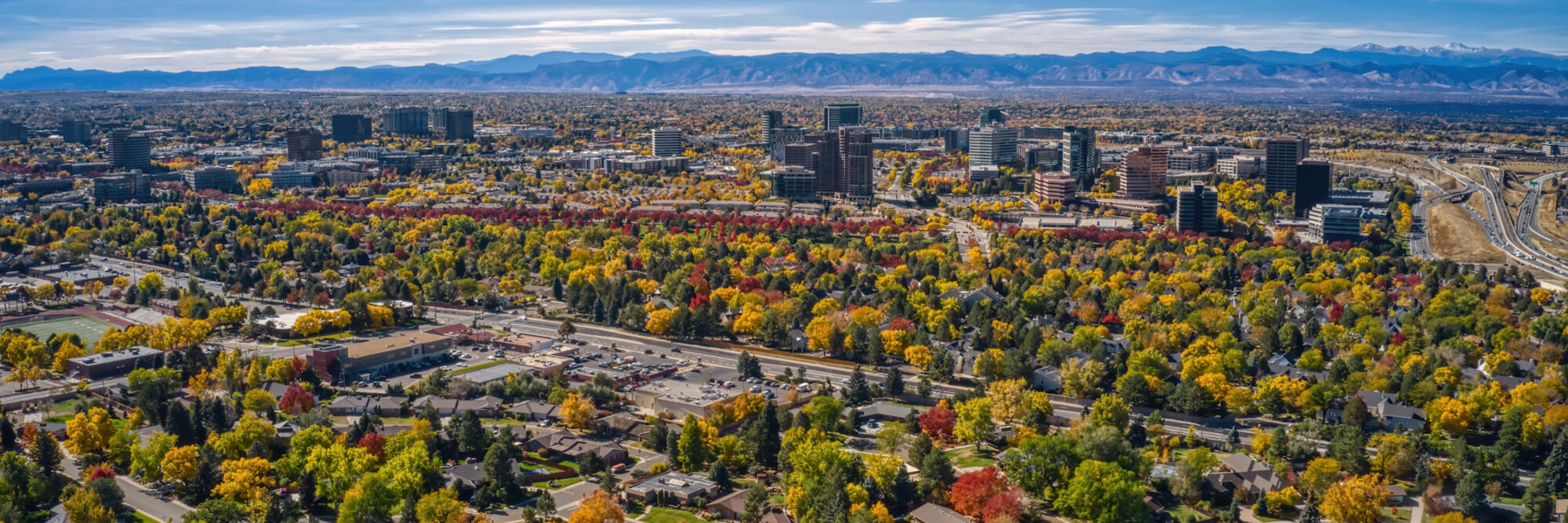
Moving to Aurora puts you in the most diverse city in Colorado, on the eastern edge of the Denver metro, where the Rocky Mountains line the western horizon. More than 160 languages are spoken across the city, and close to one in five residents was born abroad, so wherever you come from, a familiar community is likely close by.
Aurora is Colorado’s third-largest city and home to more than 400,000 people. Downtown Denver is a short way west. You can ride the University of Colorado A-Line commuter rail from Aurora’s stations to Union Station in under 20 minutes, and the same line carries on to Denver International Airport. The city supports more than 150,000 jobs, and you'll never be far from a reservoir or a trail.
Useful links
Cost of living in Aurora
The cost of living in Aurora tends to undercut neighbouring Denver in several categories, although it doesn't always fall below the wider US average. Housing is the line item with the biggest impact. Buyers priced out of Denver have long looked east to Aurora, and your rent or mortgage will almost certainly be your largest monthly outlay.
The costs of utilities and transport in Aurora are generally lower than the US average. On the other hand, groceries and healthcare are not, so the savings are patchy and largely depend on your lifestyle and health. Public transport is inexpensive, and many residents carpool to keep their commute costs down.
Getting around in Aurora
Light rail and bus routes make getting around in Aurora straightforward. The R-Line light rail runs up the Interstate 225 corridor through the heart of the city. It stops in central Aurora and at the Anschutz Medical Campus, then meets the A-Line commuter rail at Peoria Station. From there, the A-Line goes west to Denver Union Station and east to Denver International Airport.
The RTD bus routes fill in the gaps and reach parts of the city that aren’t served by trains. The city has added cycle paths and a shared mobility scheme that lets you hire e-bikes and scooters for short trips.
Useful links
Healthcare in Aurora
Healthcare in Aurora is well provided for, thanks largely to the CU Anschutz Medical Campus, the largest academic health centre in the Rocky Mountain region. Around 4,500 students train there, and roughly 21,000 people work across its hospitals and schools. You will also find well-regarded general, mental health, and dental care, and many specialists relocate to the city for work.
Healthcare is one of Aurora’s largest employers. Two major hospitals share the Anschutz campus, UCHealth University of Colorado Hospital and Children’s Hospital Colorado, and Kaiser Permanente runs medical offices elsewhere in the city.
Useful links
- CU Anschutz Medical Campus
- UCHealth University of Colorado Hospital
- Children’s Hospital Colorado
- Kaiser Permanente Aurora Centrepoint Medical Offices
Schools in Aurora
The Adams Arapahoe 28J School District, better known as Aurora Public Schools, oversees most schools in Aurora. It operates over 55 of them and teaches more than 38,000 students. If you want to enrol your children in public school, you'll find charter, magnet, vocational, and K–8 options, and the district also runs homeschool support and online learning programmes.
Three public schools in Aurora teach the globally recognised International Baccalaureate (IB) curriculum, one of them an elementary school. For a multilingual setting, families often choose the nearby International School of Denver, which teaches the IB curriculum to a community from around the world. Some private schools offer both the American and IB curricula, and several teach within a Catholic or Christian framework.
For higher education, the Community College of Aurora teaches two-year and certificate courses, while the CU Anschutz Medical Campus offers more than 40 degree programmes across six health sciences schools.
Useful links
Education and Schools in Denver
Weather in Aurora
The weather in Aurora is defined by four distinct seasons and a semi-arid, high plains climate. Winters are cold and snowy. January is the coldest month, and lows average around 22°F (-6°C). Summers are hot and bright, and the area sees roughly 245 days of sunshine a year, well above the US average. July is the warmest month, and afternoons average about 88°F (31°C).
Aurora is a dry place. It collects only about 15 to 18 inches (38 to 46cm) of precipitation a year, less than half the US average, which is part of why the Rocky Mountains stay in clear view for much of the year. The city’s elevation is roughly 5,400 feet (1,650m), at which the air holds about 15 percent less oxygen than at sea level. If you arrive from low elevation, expect to feel headachy and a bit breathless for the first few days, and to dehydrate faster than usual. Most people settle in within a week or two, although full acclimatisation can take a couple of months. Drink plenty of water and take it easy on exercise and alcohol at first. For most people, the adjustment is a minor nuisance, no more.
Snow matters here. Aurora averages around 62 inches (157cm) a year, and a mild, sunny morning can turn into a blizzard by evening. Snow or all-season tyres are worth fitting, and on Interstate 70 in the mountains, the state requires them between September and May under its traction law. Locals habitually keep a windscreen scraper in the car all year round.
Working in Aurora
Healthcare and education dominate the job market for anyone working in Aurora. Together with social assistance, they form the city’s single largest employment sector, ahead of professional and technical services, retail, construction, and hospitality. Government work adds a sizeable share too.
Buckley Space Force Base is one of the city’s biggest employers, and a lot of Denver International Airport’s transport and logistics workers live in Aurora. Plenty of residents live in Aurora for its lower housing costs, then commute across the wider Denver metro for work.
Useful links
Accommodation in Aurora
Accommodation in Aurora varies widely from one part of the city to the next. The further south and east you go, the quieter and more suburban it feels; the older north and west areas, around East Colfax Avenue, are more urban and more mixed. You can find a home here on almost any budget, so the smart move is to research neighbourhoods one by one.
Two-car households are the norm here, as they are across the suburban Denver metro, and that shows up as congestion at peak times. Consider how close a prospective home is to your workplace and your children’s school before you commit.
Families have plenty to choose from. Seven Hills is a settled, family-oriented suburb. The neighbourhood includes parks, playgrounds, quiet streets, and well-kept single-family homes. Tallyn’s Reach, further southeast, is more upmarket. This master-planned community borders the separate Saddle Rock neighbourhood and its golf course, and residents share a clubhouse with a pool and tennis courts. Both feed into the highly rated Cherry Creek School District.
Younger professionals prefer a handful of areas that all have entry-level pricing and a quick commute to the city’s main job corridors. Mission Viejo has its Spanish-style homes and mature parks. Chambers Heights is a quieter area just north of the city centre. Aurora Highlands offers newer housing that suits first-time buyers.
Useful links
Lifestyle in Aurora
For many residents, the lifestyle in Aurora is built around the outdoors. People here can easily hike, cycle, fish, and get out on the water without having to travel far.
Aurora Reservoir is the main hub for water activities. You can boat, swim in open water, fish, and dive at a designated scuba area there, mostly between spring and late October. Cherry Creek State Park is one of Aurora’s own parks. It has a swim beach and 35 miles (56km) of trail. For mountain biking and bigger hills, the foothills west of Denver are within reach, and Rocky Mountain National Park is a couple of hours’ drive. Aurora has no ski resort of its own, but Eldora Mountain makes a scenic drive into the high country.
Closer to home, the city has more than 100 parks and thousands of acres of open space. Long paved routes like the High Line Canal and Toll Gate Creek trails cross the city, and the 8.2-mile (13km) loop around Aurora Reservoir is a local favourite for cyclists and runners.
Golfers are well served. The city itself runs five public courses, and close to a dozen operate across Aurora in total. Murphy Creek, a Rees Jones design, is the pick of the award winners, while Saddle Rock and Aurora Hills round out the most played public options.
Aurora has no shortage of large malls. Town Center at Aurora is the biggest, and more than 125 retailers trade there.
Aurora’s diversity is most evident in its food. The corridors along Havana Street and East Colfax Avenue are lined with Korean, Ethiopian, Vietnamese, Mexican, and East African kitchens, and the city has a healthy crop of craft breweries to go with them. The Aurora Cultural Arts District covers a certified 16-block stretch of East Colfax. The Aurora Fox Arts Center leads its programming, and its galleries and live events round out the calendar.